
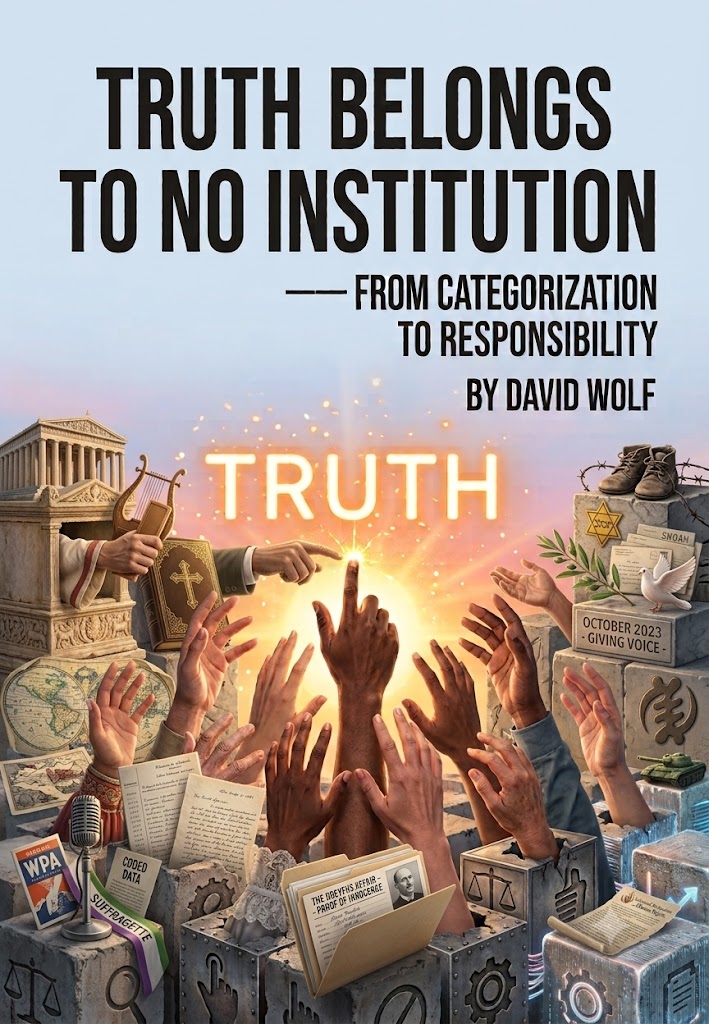
Truth Belongs to No Institution examines what happens when institutions created to seek truth—universities, courts, churches, scientific bodies, governments, and media—begin instead to certify, control, or weaponize it. Its central argument is that when an institution grants a classification the status of authoritative truth, the concrete human being—with a face, a body, and a biography—can disappear behind an abstraction.
Drawing on cases from Aristotle’s defense of natural slavery and the medieval Church to the Dreyfus Affair, eugenics, and Soviet Lysenkoism, the book traces a recurring pattern: ideas acquire language, language acquires authority, and authority becomes institutional power. It also shows how media framing, repetition, and public pressure reinforce this process.
The argument culminates in an examination of responses to the October 7, 2023 massacre, when some institutions absorbed victims into political categories before fully recognizing their humanity. Through a practical nine-question framework, the book calls for a movement from category to responsibility—restoring evidence, dissent, correction, and human consequences to the center of public judgment.
The manuscript reader described the author as “exceptionally knowledgeable” and the book as “serious and intellectually rich,” with “a strong moral voice” and “a highly relevant argument.”
“One has to belong to the intelligentsia to believe things like that: no ordinary man could be such a fool.”
—George Orwell, “Notes on Nationalism”
Education gives us the tools to think. It does not guarantee that we will use them to question ourselves. At times, it merely gives prejudice, political loyalty, and moral blindness a more sophisticated vocabulary.
Truth Belongs to No Institution is a work of political, historical, and philosophical nonfiction examining what happens when institutions created to seek, preserve, and disseminate knowledge begin instead to control, certify, or weaponize truth.
Universities, courts, churches, scientific bodies, governments, professional associations, and news organizations are indispensable to modern society. Yet none possesses truth by virtue of its name, tradition, prestige, or authority. An institution deserves trust only insofar as it remains committed to evidence, transparent sourcing, open criticism, intellectual dissent, correction, and the difficult capacity to admit error.
The book’s central concern is the moment when a category becomes more powerful than the person it describes. Once an institution grants a classification the status of authoritative truth, the concrete human being—with a face, a body, and a biography—may disappear behind an abstraction.
The book therefore distinguishes between a knowledge institution and a method of inquiry. An institution is an organizational structure; inquiry is a discipline. Institutions may continue to award degrees, publish research, convene expert panels, issue judgments, and speak with authority even after conformity, ideology, political pressure, financial incentives, or institutional self-protection have begun to replace genuine scrutiny. They may retain their power while losing something more fundamental: their right to demand trust.
The central question is not merely what is true, but how a claim becomes accepted as public truth. Who formulated it? Which institution granted it authority? What interests did it serve? What evidence was available at the time? How were contradictions and anomalies treated? Who was permitted to speak, and who was dismissed as ignorant, extremist, dangerous, or irrelevant? Through which channels was the claim framed, repeated, and emotionally absorbed by the public? And how did an intellectual abstraction eventually become policy, exclusion, coercion, or physical harm?
To make this critique practical, the book develops a nine-question framework for examining how claims acquire institutional authority, public legitimacy, and real-world consequences. The framework asks readers to identify what is being claimed, what could have been known at the time, who authorized the claim, who benefited from it, how it was disseminated and framed, how public reaction returned to reinforce the institution, and who resisted the dominant narrative—and why that resistance failed.
The book traces these mechanisms across a broad historical landscape. Plato’s “noble lie” presents political fiction as a means of stabilizing society. Aristotle gives philosophical legitimacy to the idea of “natural slavery.” The medieval Church transforms the living Jew into a theological, legal, and economic category. During the Dreyfus Affair, the military, the courts, the press, nationalism, and antisemitism converge to protect a convenient narrative at the expense of evidence and an innocent man. Eugenics allows universities, laboratories, professional organizations, and legislators to give dubious classifications coercive power over human bodies. Soviet Lysenkoism demonstrates how political authority can elevate an ideologically desirable theory while suppressing scientific criticism.
These cases are historically distinct and cannot be reduced to simplistic analogies. Yet they reveal a recurring pattern: an idea acquires a language; the language acquires authority; authority becomes institutionalized; the institution develops a system of dissemination; and the human being disappears into a useful category.
The vocabulary changes from one period to another, but the temptation remains familiar: to transform a person into a concept so that no one need look directly into that person’s face.
The media amplify this process. They do not merely transmit facts. Every headline, image, omission, and choice of terminology frames reality. Editors, journalists, owners, platforms, and audiences help determine which facts receive attention, which victims are given faces, who appears only as a statistic, and which events are interpreted before they have been fully examined.
When knowledge institutions and media systems reinforce one another, a powerful feedback loop emerges. Institutions provide authority. The media provide reach, repetition, and emotional force. Audiences provide pressure. That pressure then returns to universities, newsrooms, political bodies, and civil society organizations as further confirmation of the narrative.
No conspiracy is required. Shared incentives may be enough: ideological belonging, professional caution, institutional fear, economic pressure, and an attention economy that rewards outrage, simplicity, and certainty. The book therefore distinguishes carefully between perspective, bias, ideological framing, organizational interest, conformity, propaganda, and deliberate falsehood. Not every error is a lie, and not every shared narrative proves coordination. These distinctions do not weaken criticism; they make rigorous criticism possible.
The argument culminates in an examination of academic, media, and digital responses to the October 7, 2023 massacre and the war that followed. Instead of first encountering murdered families, kidnapped civilians, young people killed at the Nova festival, and women subjected to sexual violence as concrete human beings, some institutions immediately absorbed them into political categories such as “occupation,” “colonialism,” “resistance,” and “context.”
At that moment, the category became stronger than the person.
The Jewish case is presented not as a demand for preferential treatment, but as an acute stress test for Western institutions and for the contemporary ecology of truth. Throughout history, Jews have repeatedly been transformed from living human beings into theological, racial, legal, or political abstractions. They are rarely the only victims of such mechanisms. History shows, however, that they are often among the first.
The book does not argue that political or historical context is irrelevant. It argues that context must never erase responsibility toward the person who suffers. A framework that can explain everything yet recognize no victim has ceased to be a moral instrument.
The proposed movement from category to responsibility is therefore a demand that institutions remain accountable not only to theories, doctrines, and classifications, but also to evidence, dissent, correction, and the human consequences of their claims. It asks whether institutional language clarifies reality or conceals it; whether a category helps us understand a person or allows us to stop seeing one.
Wide-ranging in scope, intellectually and morally compelling, and highly relevant to contemporary debates about academia, media, antisemitism, political language, and institutional power, Truth Belongs to No Institution challenges readers to reconsider whom they trust, why they trust them, and what happens when authority replaces inquiry.
Truth does not require an institution in order to be true. Falsehood, however, becomes especially dangerous when the ivory tower gives it a seal of approval, the media gives it a megaphone, and the public gives it a standing ovation.