
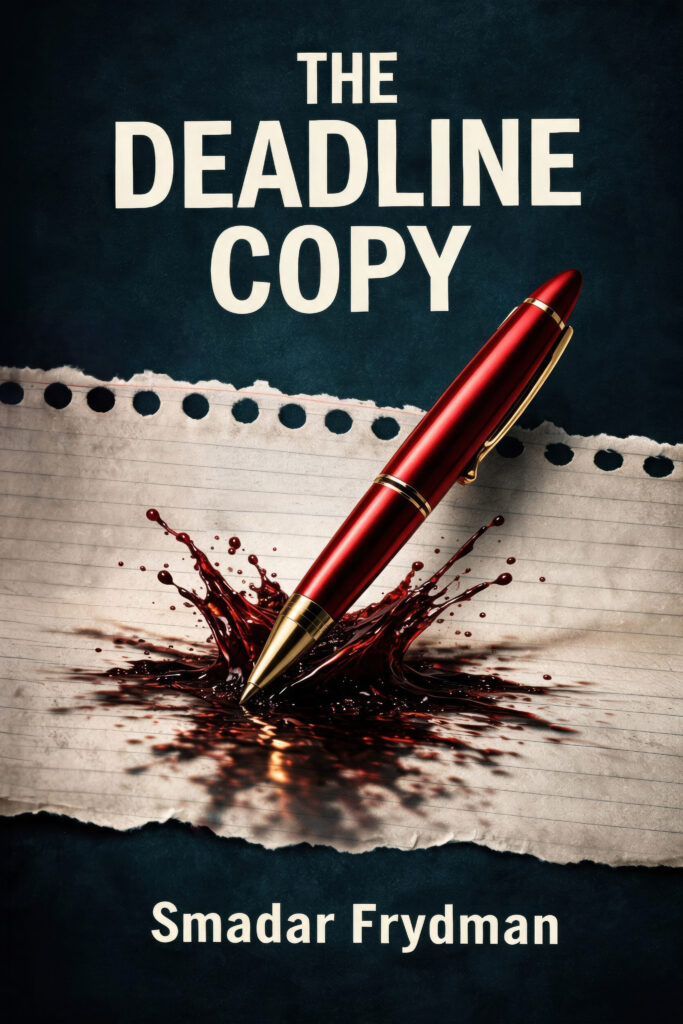
A brilliant but controversial young copywriter is found dead in his office at a prestigious advertising agency in the heart of Tel Aviv. What first appears to be a tragic death caused by a severe medical condition takes a darker turn when his life-saving epinephrine injector is found to be missing. The investigation falls to Natalie Azikri, a young police investigator badly in need of a professional success. On the agency side are Lian Kressman, an ambitious account executive, and Yaron, her devoted young assistant. But Archetype has no time to stop. The agency is in the final stages of a career-defining pitch for a revolutionary new product, and the pressure to win is relentless. As the investigation moves through a maze of bruised egos, professional rivalries, personal betrayals, and fiercely guarded ambitions, the advertising world’s polished surface begins to crack. At the same time, the case reaches far beyond the question of who killed Alex. Natalie, Lian, and Yaron are each forced to confront the personal cost of choices made in professions that demand almost total devotion, and the fragile lives that remain when work has consumed too much of everything else. As the pieces finally begin to fall into place, an unexpected twist casts the murder, and the story itself, in an entirely different light. Three versions of the truth remain. Any one of them could be the real one. At its heart, The Deadline Copy is a psychological crime thriller about ambition, professional obsession, and one of the most powerful human needs of all: to belong and to be loved.
Tel Aviv, 2014. At Archetype, a leading advertising agency, work has never been just work. Its employees live by deadlines, sacrifice relationships and personal lives, and measure themselves by the next account, the next idea, the next victory. Beneath the creativity and glamour lies a more fundamental hunger: to succeed, to be recognized, to be loved, and to belong. Now those pressures have peaked. Archetype and its major rival, Colleague, are the final two agencies competing for a prestigious wearable-technology account that could determine Archetype’s future. Winning would mean money, status, and security. Losing could mean layoffs or even a merger. For everyone involved, the pitch has become all-consuming. Four days before the final presentation, twenty-seven-year-old copywriter Alex Mikhailov is found dead in his office. Lian Kressman, Archetype’s Head of Account Management, discovers the body. At almost thirty, Lian is already one of the agency’s veterans: ambitious, highly competent, and almost entirely consumed by her career.
She knows the price of her profession: punishing hours, abandoned relationships, and endless deadlines. Still, she has always accepted it as inseparable from work she loves and excels at. Even in the aftermath of Alex’s death, part of her mind is calculating what his absence will mean for the pitch. Alex was brilliant, abrasive, and ambitious, a gifted copywriter on the verge of becoming Creative Director. He was also severely allergic to milk. His swollen face and skin rash point to anaphylactic shock, and the autopsy appears to confirm it. But Alex’s epinephrine injector, which he habitually carried, is missing. Senior police investigator Natalie Azikri takes the case at a vulnerable point in her career. Several unresolved investigations have weakened her standing within the department, and solving this one could help restore it. What initially looks like an accident soon raises questions. Why would a man with a life-threatening allergy be without the medication that could save his life? Was the injector lost or deliberately removed? Was his exposure to milk accidental? Many people have reasons to resent Alex. His talent came with arrogance and a capacity to humiliate colleagues, appropriate others’ ideas, and threaten careers. In the feverish atmosphere of a career-defining pitch, professional rivalries have become intensely personal. Then the pathologist finds something that does not fit: damage to Alex’s liver and kidneys that cannot readily be explained by anaphylaxis. Routine toxicology provides no answer. While Natalie follows one lead after another, Alex’s death begins to unsettle something in Lian that has little to do with the investigation. The pitch continues; deadlines do not stop for death. Lian remains fiercely committed to Archetype and protective of its interests. Yet gradually, the relentless pressure surrounding the tender, and the lives she sees narrowing around work, force her to confront something she has long avoided. She has given almost everything to a career she loves. But professional success may no longer be enough to define how she wants to live. Her transformation is not a rejection of ambition.
What changes is her conviction that achievement alone is sufficient as a measure of a life. For the first time, she begins to imagine wanting something beyond the next promotion, pitch and victory. The apparent solution to Alex’s death comes from someone few would suspect. Yaron, Lian’s young account coordinator, is quiet, meticulous, and compulsively helpful. He anticipates her needs and watches over her with a devotion that initially appears harmless. But beneath it lies a childhood shaped by fear. Yaron grew up with a violent father whose unpredictable rages kept him and his mother under constant threat. As a boy, he lived with the helplessness of being unable to protect her. After a terrifying confrontation ended with his father’s death, his mother told him that he was now her protector. The role never left him. Years later, Alex begins to occupy the same psychological space. His aggression and increasingly threatening behavior toward Lian echo Yaron’s father. To Yaron, Lian is no longer simply his boss, and Alex is no longer merely a difficult colleague. An old pattern has re-formed: someone he cares about is threatened by a man who resembles the figure he once feared and was powerless to stop. This time, Yaron will not remain powerless. Eventually, overwhelmed by guilt, Yaron confesses to Lian. He admits deliberately engineering Alex’s exposure to milk but insists he never intended to kill him. He wanted Alex to become ill enough to be taken to the hospital and removed from the crucial work on the pitch. He believed Alex had his epinephrine injector and would survive. Lian turns him in. Yaron’s confession appears to provide a solution, but Natalie remains uneasy. The missing injector is still unexplained. So is the damage to Alex’s liver and kidneys. After a trip to India, where Natalie learns about the lethal effects of poisonous mushrooms, she makes a connection that had previously eluded her. She asks the pathologist to re-examine preserved tissue and evidence from the scene for traces of a fungal toxin. The results are suggestive but inconclusive. She is left with the disturbing possibility that the allergic reaction concealed another cause of death, but she cannot prove it. The legal case therefore proceeds on the truth Yaron has chosen to reveal. Four months later, he is sentenced to six years in prison. The court has its answer. Natalie does not have all of hers. The reader, however, is now offered what seems like a deeper truth. A chapter from Yaron’s perspective suggests that his confession concealed the most important part of his plan. According to this account, Yaron prepared an extract from a poisonous mushroom and injected it into Alex’s can of Coca-Cola. He then engineered Alex’s exposure to milk. The allergic reaction was camouflaged. Anyone finding Alex swollen, covered in a rash and struggling to breathe would see what his medical history told them to see: anaphylaxis. The mushroom toxin could remain hidden behind an obvious medical explanation. Yaron could not have anticipated one element. Earlier, during a meeting with Orit at a café, Alex’s epinephrine injector had fallen from his bag. No one stole it. No one hid it. To Natalie, its disappearance remains an unresolved piece of the case; only the reader can deduce what happened to it. The pieces now seem to fit: the milk, the unexplained organ damage, the poisonous mushroom, Yaron’s partial confession, and the missing injector. Or so it seems.
Fifteen years later, a man named Danny sits in a fiction-writing workshop with his writing partner, Rinat. They have submitted a story called The Deadline Copy. As the group debates whether its gentle, devoted character Yaron could plausibly become a killer, Danny grows increasingly distressed. Memories surface that mirror Yaron’s: the violent father, the endangered mother, the childhood terror, and the compulsion to protect. Danny, it emerges, once served time in prison. A prison psychologist encouraged him to turn his experiences into fiction as a way of confronting his guilt. But Danny never told even the psychologist the whole story. The apparent revelation of Alex’s murder is destabilized once again. Is Danny actually Yaron fifteen years later, transforming his crime into fiction? If so, was the account of the poisonous mushroom a confession, a reconstruction, an act of self-justification, or an invention? The novel ultimately leaves three levels of truth in tension. There is the truth accepted by Lian, Natalie, and the court: Yaron deliberately triggered Alex’s allergy but did not intend to kill him. There is the deeper version offered to the reader: the poisonous mushroom, the carefully constructed camouflage, and a murder rooted in Yaron’s compulsion to protect. And beyond both lies what actually happened. The court reaches a verdict. Natalie is left with suspicions she cannot prove. The reader is given more than either of them, but not the certainty of knowing what really happened to Alex Mikhailov. The Deadline Copy is a psychological crime thriller set against the ruthless world of advertising, where professional ambition consumes personal lives, and the need to succeed collides with an equally powerful need to belong, to be valued, and to be loved.