
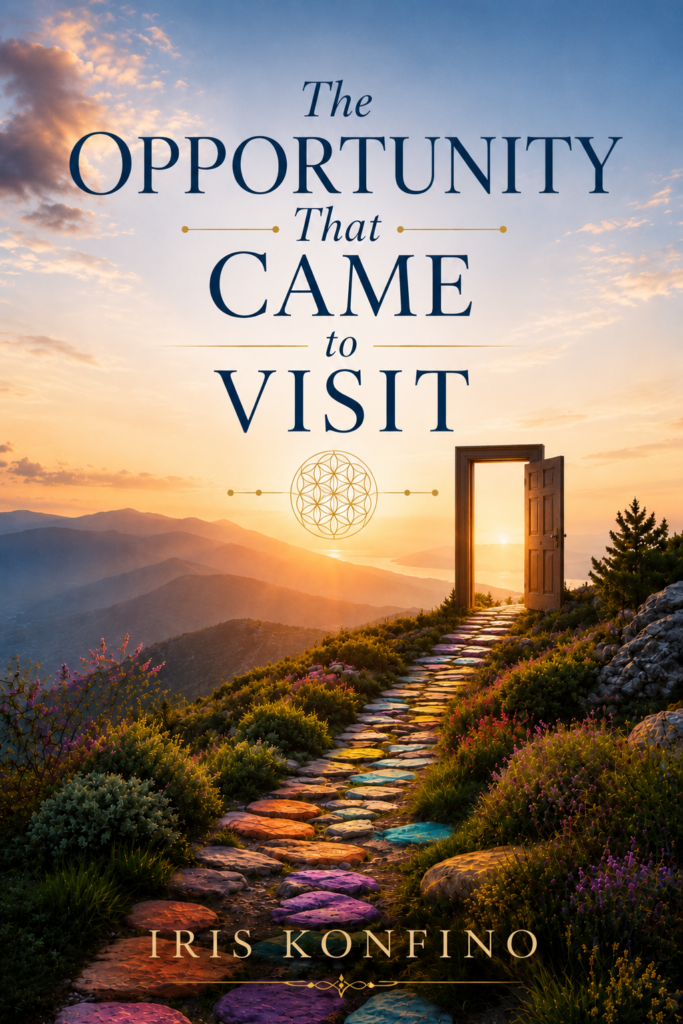
The Opportunity That Came to Visit by Iris Konfino is a personal guide to inner transformation rooted in the belief that all reality is made of energy expressed through frequencies — each one a teacher rather than a flaw. The outer world is understood as a mirror of the inner world, meaning that whatever provokes us externally points to something within us that seeks healing. Fear is reframed as a doorway appearing precisely at the threshold of growth, while anger — when expressed consciously — becomes a powerful agent of healing and boundary-setting. The “Drama Triangle” of Victim, Rescuer, and Aggressor is examined as a universal fear-based pattern that governs relationships until brought into conscious awareness. Awakening is described not as a single dramatic event but as a layered, ongoing process of returning to an inner light that was never truly lost — because life, at its core, is a journey of remembering who we have always been.
The Opportunity That Came to Visit is the first of two major books describing the journey of human awakening. The second book, The Awakening, continues the process and enters into the depths of the encounter with the soul, the inner child, and the forces of symbols that accompany a person on the journey of their life.
The Opportunity That Came to Visit is a personal, experiential guide to inner transformation, written by Iris Konfino — a practitioner and observer of human consciousness, not a clinician. The book blends memoir, spiritual reflection, practical exercises, guided meditations, and journaling prompts into a unified exploration of what it means to become truly awake to oneself. Structured in three parts — Consciousness, a Dream Work Guide, and a Healing section — the book traces a comprehensive map of the inner life, from the nature of energy to the meaning of death.
Energy and Frequency
The book opens with the premise that all reality is made of energy, constantly in motion and expressing itself through a spectrum of frequencies — low, medium, and high. These frequencies are not moral categories but teachers: low frequencies (fear, pain, lack) awaken the desire to move; medium frequencies (courage, forgiveness, compassion) drive learning and transformation; high frequencies (peace, harmony, inner truth) enable integration and application.
The interplay between them is understood not as conflict but as the natural rhythm through which life teaches and balances itself.
The Laws of the Universe
From energy, the book moves to universal laws, particularly the law of attraction — the idea that the frequency we habitually inhabit draws matching experiences toward us — and the law of reflection. The latter is central: the outer world is understood as a mirror of the inner world. Whatever provokes an extreme reaction in us points to something within that seeks acknowledgment and healing. This framework shifts the reader from victimhood to curiosity: external friction becomes a signal to look inward rather than an injury inflicted from outside.
Responsibility
The law of reflection leads naturally to the theme of responsibility — not as blame or shame, but as the empowering recognition that we are co-creators of our experience. The book distinguishes between “responsibility as guilt” and “responsibility as creative presence.” To take responsibility means to ask not “who did this to me?” but “what is this here to teach me, and how do I choose to respond?” This is presented as the turning point from victimhood to genuine freedom.
Fear
Fear is examined as one of the most powerful energies in human life. The book argues that while some fear is healthy — a protective instinct — most adult fear is learned, originating in childhood environments and projected onto present circumstances as if past dangers still exist. Fear functions as a gatekeeper that, when unexamined, imprisons rather than protects. Yet when approached consciously, fear reveals itself as a doorway: it appears precisely at the edge of growth, signaling readiness for the next stage of inner development.
Anger
Anger receives a similarly nuanced treatment. Rather than pathologizing anger, the book frames it as an expression of blocked life-force energy — a signal that something has been violated or suppressed for too long. Anger that goes unexpressed does not disappear; it turns inward as depression, chronic tension, self-criticism, or emotional numbness.
The book advocates for mature anger: feeling and expressing it without harming others, setting clear boundaries, and understanding anger as an alarm system for the soul rather than a character flaw.
The Senses, Giving, Acceptance, and the Victim Triangle
Subsequent chapters explore the five senses as pathways to healing once emotional storms settle; the dynamics of giving and receiving (how giving from fear or resentment weakens both giver and recipient, while giving from genuine choice nourishes both); and the paradox of acceptance, particularly the difficulty of receiving from others when one is accustomed to giving. The book also addresses the “Drama Triangle” — the roles of Victim, Rescuer, and Aggressor — as universal strategies of fear-based survival that keep people trapped in repetitive patterns until they are brought into awareness.
Destiny, Death, and Awakening
The later chapters turn toward larger existential themes: the nature of soul purpose, the meaning of life transitions, the spiritual significance of death not as an end but as a threshold, and the experience of awakening itself. Awakening is described not as a single dramatic event but as an ongoing, layered process — a gradual return to the inner light that was never truly absent. The book’s central conviction, stated plainly in its final pages, is that life is not a test or a punishment but a journey of remembering who we have always been.
Throughout, the book is grounded in the author’s personal story and clinical experience, maintaining a tone that is warm, honest, often humorous, and consistently inviting rather than prescriptive.
The Opportunity That Came to Visit is the first of two major books describing the journey of human awakening. The second book, The Awakening, continues the process and enters into the depths of the encounter with the soul, the inner child, and the forces of symbols that accompany a person on the journey of their life.