
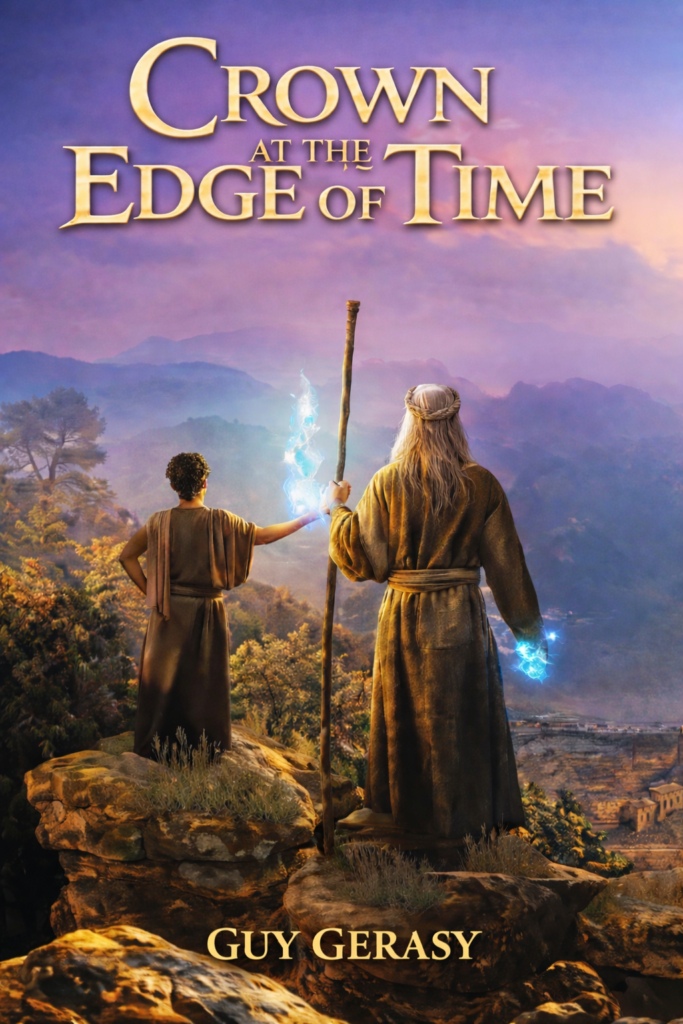
When farm boy Tzach encounters prophet Ahijah and rebel Jeroboam, his life transforms forever. As King Solomon’s death triggers Israel’s division, Tzach trains in mystical arts, discovering dark sorcerers seek to make the split permanent. In a climactic battle blending political intrigue and spiritual warfare, he must preserve hope for reunification.
Kingdom in Fractures is a sweeping biblical fantasy novel set during one of ancient Israel’s most tumultuous periods—the division of the united kingdom following King Solomon’s death. The story masterfully weaves together political intrigue, spiritual warfare, and personal transformation against the backdrop of a nation tearing itself apart. The narrative centers on Tzach, a young farm boy from the small village of Tzemarim, whose ordinary life is upended when he encounters the prophet Ahijah and the rebel leader Jeroboam on a dusty road. This chance meeting becomes the catalyst for an epic journey that will see him transform from a naive shepherd into a powerful wielder of mystical forces, tasked with preserving the fragile unity of Israel. The novel opens with Tzach falling asleep in the fields while working with his older brothers—Aviail, Yehiel, and Eira. When he awakens, he encounters a mysterious man on a donkey wearing an ornate cloak. This stranger is revealed to be Ahijah the prophet from Shiloh. Shortly after, Jeroboam arrives—a powerful leader fleeing from King Solomon after a failed rebellion. In a pivotal scene, Ahijah tears his cloak into twelve pieces, giving ten to Jeroboam, prophesying that God will rip the kingdom from Solomon’s hand and grant ten tribes to Jeroboam. Tzach, exhausted and dehydrated from his ordeal, is recruited by Jeroboam to help him escape the king’s forces. This seemingly random encounter sets Tzach on a path that will intertwine his fate with the future of the kingdom. Jeroboam, despite being a wanted fugitive, carries himself with regal bearing and demonstrates remarkable charisma and leadership. The story then shifts back two years to Jerusalem, where we follow Yehiel, Tzach’s brother, who has volunteered for the king’s corvée labor. In the capital, Yehiel is drawn into the growing tensions between the northern tribes and the house of David. He meets Jeroboam and becomes captivated by his vision of justice and equality for the northern tribes, who feel oppressed under Solomon’s heavy taxation and forced labor policies. This experience plants the seeds of rebellion in Yehiel’s heart. Meanwhile, Tzach begins studying with an enigmatic old man in his village—a mysterious figure who possesses profound mystical knowledge. This elderly teacher, who remains nameless for much of the story, instructs Tzach in the hidden arts of manipulating reality through the sacred names of God and understanding the deeper layers of existence. Through rigorous and often dangerous training, Tzach learns to move objects, split the earth, and wield forces beyond ordinary comprehension. The old man’s teachings are steeped in Kabbalistic tradition, focusing on intention (kavanah), the power of sacred letters, and the connection between spiritual and physical realms. The political situation escalates when King Solomon dies and his son Rehoboam ascends to the throne. The northern tribes, led by Jeroboam who has returned from exile in Egypt, travel to Shechem to meet with the new king. They make a simple request: lighten the heavy burden that Solomon placed on them. Rehoboam, in a catastrophic error of judgment influenced by his young advisors, refuses their plea and instead promises to increase their hardships. This rejection triggers the prophesied division. The ten northern tribes rebel and declare Jeroboam their king, while only Judah and Benjamin remain loyal to Rehoboam and the house of David. The unity forged by David and Solomon shatters, fulfilling Ahijah’s prophecy. However, the novel reveals that darker forces are at work behind the political maneuvering. A network of sorcerers and dark practitioners, led by a mysterious figure named Orian (later revealed to be the old man’s former student who turned to forbidden arts), seeks to accelerate the kingdom’s destruction. They employ Egyptian magicians, Edomite warriors, and Amalekite mercenaries to ensure the division becomes permanent and irreversible. Tzach’s family becomes deeply embroiled in the conflict. His father Aviail, fiercely loyal to the house of David, attempts to assassinate Jeroboam but is stopped by Yehiel, who has become one of Jeroboam’s closest supporters. This creates a painful rift within the family, with brother set against brother and father against son, mirroring the larger national division. The story builds toward a climactic confrontation in Shechem during Rehoboam’s coronation ceremony. Multiple factions converge with conflicting agendas: Jeroboam seeking to establish his legitimacy as king of the north; Rehoboam’s forces trying to maintain unity by force; Egyptian agents working to weaken both kingdoms; and the dark sorcerers attempting to perform forbidden rituals that would make the division permanent and catastrophic. Tzach discovers that the mystical battle is as crucial as the political one. Orian, his teacher’s wayward student, has embraced forbidden powers and seeks to destroy the Temple in Jerusalem spiritually by severing the unity of the people. The novel presents a profound theological argument: the Temple’s physical existence depends on the nation’s unity. Without that unity, the spiritual center cannot hold. In the intense final sequences, Tzach must use everything he has learned to combat shape-shifting creatures, resist powerful sorcerers, and ultimately save King Rehoboam’s life. His sister Shirah, a prophet in her own right, and a mysterious young girl named Miriam (who possesses extraordinary abilities) become crucial allies. The old man confronts Orian in a devastating mystical duel that claims both their lives, but not before ensuring that a kernel of hope remains. The novel concludes thirty-six years later with an aged Tzach teaching a young student, reflecting on those tumultuous days. While the kingdom remains divided, the fact that Benjamin stayed with Judah left a window of possibility for future reunification. Tzach acknowledges that their struggle, while unable to prevent the split, preserved the potential for eventual healing. Kingdom in Fractures is ultimately a meditation on the cost of division, the power of faith, and the hidden battles that shape visible history. It portrays the Israelite schism not merely as a political event but as a spiritual catastrophe with mystical dimensions, where the actions of individuals ripple through generations and the choices made in crucial moments echo through eternity.