
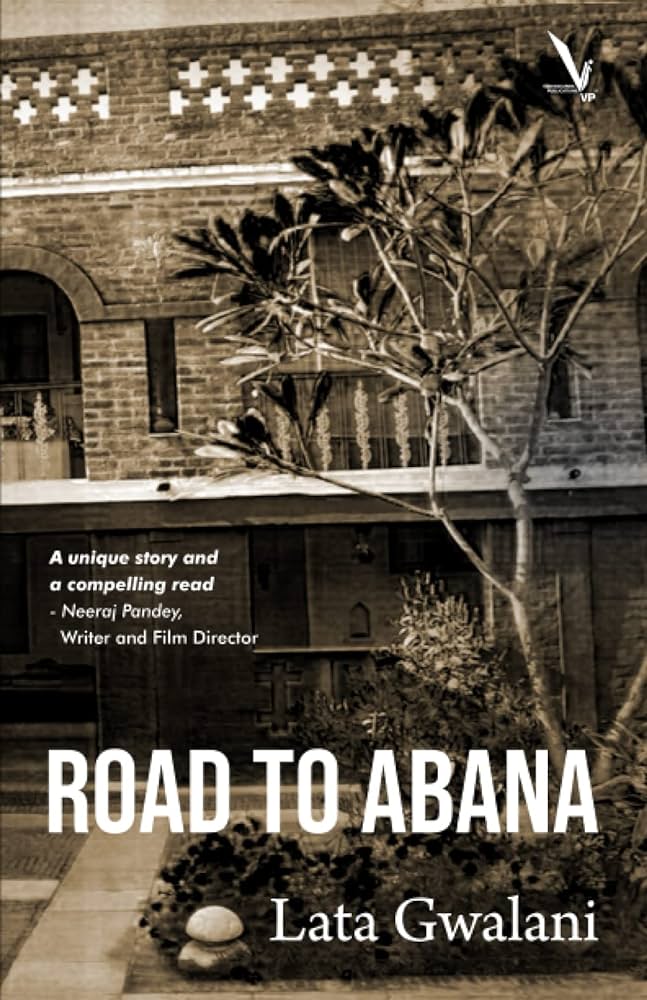
After the 1947 partition of India uproots her from her home in Sind, a widowed refugee’s yearning to return to her home pulls her into an international arms-smuggling network spanning Dubai, Karachi, and Kandahar. The novel traces how exile hollows the self, and how a woman, once reduced to a carrier of other people’s wars, claims authorship over her own survival. Combining the emotional force of Partition literature with the propulsion of a geopolitical thriller, Road to Abana speaks to contemporary questions of borders, displacement, and women’s agency in conflict zones.
For an exile, the journey back home is the toughest. Road to Abana follows Paari, a young Sindhi widow rendered homeless by Partition, whose singular obsession is return: return to a house she calls Abana, return to a city that may no longer exist as she remembers it, return to a self that has been scattered by exile. With no money, no kin, and no social protection, Paari becomes what many displaced women quietly become: a body that travels for others’
profit. She is caught at Dubai airport smuggling gold bangles into India, one of the many nameless carriers who ferry contraband across new borders carved by old empires. The man who detains her, Shaqib, is not an official authority but an arms agent. He sees her desperation, her recklessness, her hunger for return. He offers her a bargain. If she carries guns from Dubai to Karachi, he will let her cross into Pakistan. For Paari, the promise of Sukkur, her homeland, is stronger than fear. She agrees.
Thus begins her descent into a shadow world of smuggling routes, false passports, desert crossings, and silent agreements. Paari becomes a regular carrier of arms between Dubai and Karachi, reporting – like Shaqib – to an unseen figure known only as “Veeh.” In this underworld, she learns the grammar of power:
obedience rewarded, hesitation punished, women’s bodies treated as collateral. Shaqib exploits her sexually, and she endures it in silence, believing that suffering is the toll one pays to go home. Her first visit to Sukkur is devastating. The town is unrecognizable: altered by time, by politics, by the scars of violence. Under surveillance, she walks through streets that once knew her footsteps. On her second visit, chance intervenes. She runs into Virmal, her childhood love now a prosperous dry-fruit trader who had managed to return to Sukkur in the early years after Partition. Their meeting is tender, startling, and charged with everything they lost. Virmal leads her to Abana. The house stands there with a modern façade, stripped of memory, but still breathing with the residue of their shared childhood. Their reunion rekindles love, but more importantly, it reignites Paari’s sense of belonging. For the first time since 1947, she does not feel like a trespasser in her own past.
She returns to Dubai carrying hope, believing her road back to Abana has finally opened. Instead, she finds Shaqib replaced by Zain. Her assignment shifts. She is now to be based in Karachi, running guns to Kandahar, Afghanistan. The network is expanding; the routes are more dangerous; the stakes are higher. But Paari agrees. The deal is sweetened: after every successful run, she will be allowed ten days in Sukkur. The promise of Abana still governs her choices. Her journey to Kandahar is brutal. Physically punishing, morally corroding. Yet she completes it. What she does not know is that the unseen mastermind of this network, the elusive “Veeh,” is Virmal himself. The 1 man who led her back to her childhood home is the same man using her as his most reliable asset in an arms empire spanning Dubai, Karachi, and Afghanistan. Her longing for Abana has been weaponised against her.
The revelation comes from an unlikely source: Shaqib, who turns traitor and exposes Virmal’s duplicity. In that moment, the private wound of betrayal becomes a political awakening. Paari realises that she, Shaqib, Zain, and aira, each compromised in different ways, are all expendable pieces in Virmal’s consolidation of power. The childhood lover who symbolized return has become the architect of war. The reckoning unfolds in Sukkur, where personal history and scruples collide. When Virmal is finally taken down, Paari stands in the ruins of her illusions. Yet what remains is not only loss. It is agency. Paari reclaims Abana, not as a relic of innocence, but as a base of power. From her childhood home, she builds an all-woman network of carriers and negotiators. Women who, like her, were displaced, discarded, and taught to survive in the margins. Together, they operate in the arms trade not as silent mules but as strategists, choosing who they supply and why. Paari becomes a formidable figure in the region’s underworld, but her operations are no longer driven by blind allegiance to profiteers. She supplies those fighting to protect their homelands, their Abana, those resisting erasure.
Road to Abana is not a tale of redemption in the conventional sense. Paari does not step out of violence into purity. Instead, she steps into authorship of her own survival. The novel traces how exile hollows a person, how longing can be exploited, and how love—personal and political—can become indistinguishable from betrayal. At its heart, it asks: hat does “home” mean when home has been weaponised? And what kind of power is left to those who were never meant to survive history’s rearrangements? Set against the aftershocks of Partition and the covert economies of South Asia and the Middle East, Road to Abana is a story of a woman who travels through borders, bodies, and moral fault lines in search of belonging, and ends up building a dangerous, defiant version of home on her own terms.