
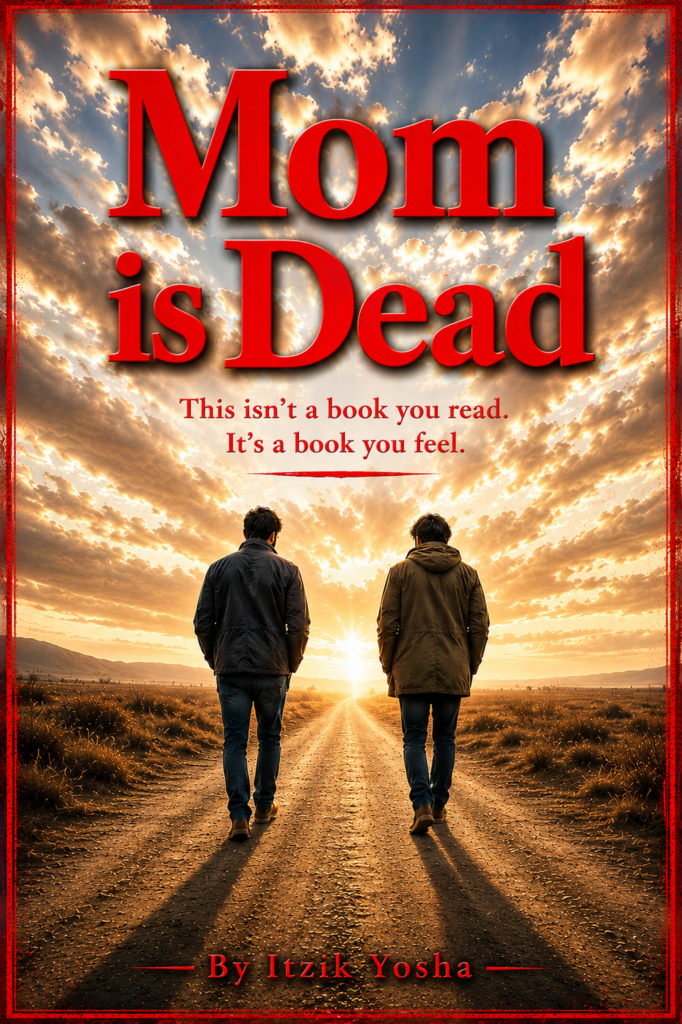
Mom Is Dead is a book about a man who grew up in a home scarred by violence, neglect, and humiliation — and about the wounds that never fully heal. It grapples with the question of what becomes of a child denied a mother’s love, and how he carries that deprivation into adulthood. The book examines the divergent ways in which three children, raised under the same roof and exposed to the same trauma, emerge from it utterly transformed in different directions. It is preoccupied with memory, and with the unsettling truth that the past is borne not only in the mind but in the body itself. At its center lies a meditation on forgiveness — whether it is an obligation, whether it is even possible, and whether the refusal to forgive may itself be a vital, life-sustaining force.
The book also asks what parents truly bequeath to their children — not through wills and testaments, but through conduct — and how cycles of violence are transmitted across generations. Yet alongside this, it is a book about the possibility of breaking that cycle: through conscious parenthood, through the long labor of therapy, through the daily choice to act otherwise. It is a book about brotherhood forged simultaneously too late and not a moment too soon, and about the discovery that a sibling can become one’s only true home. Finally, it is a book about the gap between what we long to feel in the face of death — grief, release, absolution — and what we actually feel when the moment arrives. And through all of this, it is a book about the quiet triumph of one who has built a life from the dust.
Mom Is Dead is a short, near-monologic novel narrated in the first person. The protagonist, Uri, a middle-aged gay man, has been living in Athens for five years, attempting to leave behind a painful childhood and a no less painful adulthood. The book opens with a brief phone call from his sister Dvora, who informs him — without preamble — of their mother’s death. From that terse announcement unfolds a vast interior journey: Uri retraces decades of life lived in the shadow of a mother who was, by his account, a source of fear, violence, and abandonment — never of love.
At the heart of the novel lies the journey back: Uri’s older brother Kobi arrives in Athens, and the two fly together to their homeland. The flight itself, and their subsequent days in the childhood home in Givat Shmuel on the eve of the funeral, become a rare and overdue reckoning. Uri and Kobi, who for years kept one another at arm’s length, open for the first time an honest conversation about what it meant to grow up in a home marked by violence.
Together they reconstruct painful memories: from the private names Uri gave to childhood recollections — among them the scene in which their mother dragged Kobi by the ear to dispose of rotting vegetables — to the nights she beat, pinched, humiliated, and cast her sons out into the street. Alongside the cruelty, deeper wounds surface: Uri recounts being left alone in a crib for hours at a time while his mother went to work — a revelation Kobi hears for the first time and cannot bear. Another formative memory is the first day of school: Uri arrived alone and late, led by his grandmother with her headscarf, and sat himself in the front row like a child determined to forge armor from his own humiliation.
Against this backdrop, the mother’s own voice surfaces in a rare moment Uri recalls with piercing clarity — she sat knitting, her spirit unusually gentle, and Uri managed to draw from her a few sentences about her own harsh childhood: a tyrannical father who tormented both her and her mother, years of grueling labor, and the devastating fact that she had been married off at the age of fourteen and a half — a truth she herself did not discover until years after the wedding. Indeed, one of the novel’s most shattering revelations, arriving in the shadow of her death, is that their “cousin” Asa is no cousin at all: he is the son of their Aunt Malka, who was repeatedly raped by their grandfather Abraham, and is, in truth, their mother’s half-brother. This disclosure adds yet another layer to the puzzle of intergenerational cruelty that Uri has spent his life trying to dismantle.
The question of forgiveness runs throughout the book. Kobi, who lives in Norway with his wife Nirit — a loving, perceptive woman who taught him to weep, to rage, and to love all at once — speaks of forgiveness as a force that clears space for life. Uri, by contrast, refuses to forgive, and makes no apology for it. He regards that refusal as a life force in its own right, a moral entitlement to stop absorbing what was done to him. And yet, between the two brothers, an intimacy takes shape that neither has ever known: long conversations over two nights before the funeral, shared tears, embraces, and words long withheld. Kobi confesses that he too, at times, joined in the humiliations visited upon Uri, and asks for forgiveness. Uri grants it without hesitation.
Set against the funeral’s procession, and in sharp contrast to it, the figure of their sister Dvora emerges as someone who has internalized the family’s poisoned legacy while simultaneously denying it — orchestrating the burial as a theatrical production, delivering a dishonest eulogy laden with praise that Uri finds wholly contemptible.
The reading of the will reveals that their mother left half her estate to Dvora, “the beloved of my heart,” while the remaining half is divided between Kobi and Uri — a final gesture that, in Uri’s eyes, encapsulates a lifetime of favoritism and belittlement, and confirms that she chose, to the very last, discord over reconciliation. From the family’s lawyer, Uri learns in a half-sentence that he was saved from total disinheritance.
Among the secondary figures, the neighbor Naomi stands out — the woman who once found young Uri sleeping in a bomb shelter after his mother had thrown him into the street, and who, years later, appeared again at the shiva for her husband. Now she materializes once more, with an almost mystical precision, at the very moment Kobi steps away from Uri’s side at the graveside, and places her hand gently on his shoulder. Equally present throughout the novel is Uri’s son Ilai, born of a co-parenting arrangement with his friend Lilach. The upbringing Uri gave Ilai — attentive, tender, fully present — is rendered as a life’s work of repair: what our parents did, you shall not do. Ilai stands as living proof that another way is possible.
The funeral itself is described with an unflinching clarity: no sharp grief for the mother, no tears shed in her memory — but a deep and luminous emotional presence in the form of the two he loves most, his son and his brother. Standing at the open grave, Ilai’s hand on one shoulder and Kobi at his other side, Uri feels for a moment a quiet triumph — the triumph of a life built from the dust.
Mom Is Dead is a book about an orphanhood that has nothing to do with biological death — an orphanhood that begins when the infant is still in the crib. It is a book about a language never learned at home, the language of compassion, closeness, and solidarity, and about the belated attempt to construct it. Two brothers, standing over their mother’s grave, find each other for the first time — and with a reverent trembling that lifts the heart, they choose the day after, and they choose life.