
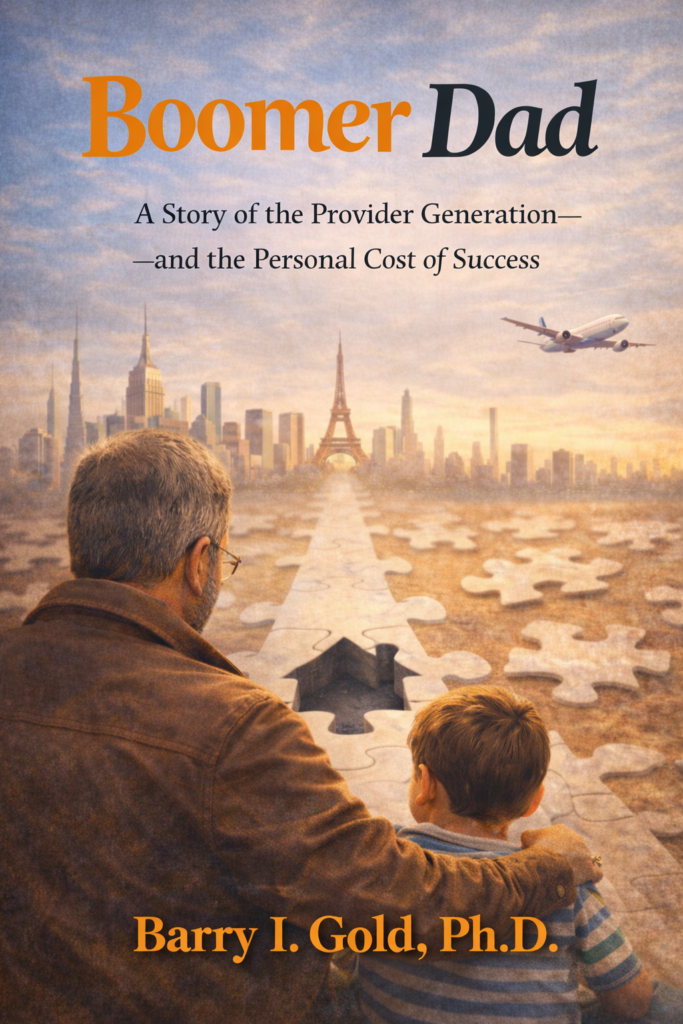
“Boomer Dad” is a lively memoir of reinvention by Barry I. Gold, Ph.D.—a Baby Boomer with children ranging from their early fifties to a teenage son. After facing early academic setbacks, Barry transitions into international drug development, learns new languages, and travels across Europe until a heart attack follows an open-heart surgery, forcing him to reevaluate his life. Amid divorce, a new seven-year relationship, and an unexpected second act as a published author and addiction specialist, the book emphasizes a timely theme: despite a high-powered career, extensive global travel, and an outwardly successful life, Barry recognizes he has been neglecting his most vital assets—his health and close family connections. The book exposes the modern trap of achieving success at the expense of your own life. The story is about moving forward and discovering what it truly takes to reconnect.
Boomer Dad is a lively, clear-eyed memoir about reinvention—and the modern trap of being “successful” and still missing your own life.
Barry I. Gold, Ph.D. is a Baby Boomer whose family story stops people in their tracks: his children span four decades, from two grown kids in their early fifties to a teenage son. That unusual reality isn’t a gimmick—it’s the result of a life built in chapters: two marriages, two divorces, and a career that kept demanding more time, more travel, more focus.
Barry’s early plan was academia, until a major roadblock—he didn’t receive tenure. So he pivots. He moves into pharmaceuticals, then quickly realizes he doesn’t want to spend his life in a lab. He pivots again, into managing drug development. And when he learns the rules of international leadership—if you manage Europeans, you show up in Europe—he commits fully. Soon he’s crossing the Atlantic every two weeks, learning German (and a bit of French), driving through different countries, different rules, different clocks, and building a life that looks impressive from the outside: business-class travel, high-stakes responsibility, and influence in an industry that moves billiomaterialsns.
But the body keeps the receipts.
At fifty-two, Barry suffers a heart attack that leads to open-heart surgery—a jarring interruption that forces a reset he didn’t choose. He goes back to work anyway, because that’s what high performers do. And yet the deeper wake-up call isn’t only medical. It’s personal. Over time, career momentum and relationship fractures leave him facing what many people—across countries, careers, and generations—eventually confront: you can work your way into success and still drift away from your own life.
Boomer Dad doesn’t preach. It observes. It follows Barry through the breaks and the rebounds: divorce, then an unexpected new relationship that begins in a hospital cafeteria and lasts seven years; the realization that his older children are partly estranged because he didn’t do the hard work of blending the family; the day-to-day challenge of being a father again as a single parent to a teen—while his other children are already adults with lives of their own.
Then comes the surprise second act: writing. Barry starts later in life, wins a contest, gets published, keeps going, and discovers a new kind of achievement—one that isn’t measured by flights or titles, but by meaning. He becomes a public voice, appearing on TV and radio, and he leans into what he does best: speaking to college-educated non-scientists in a smart, accessible way, including on addiction-related topics.
Ultimately, Boomer Dad is a story for anyone who has ever looked up and realized time passed faster than they expected. It’s about the moment you understand that the most important things—health, family, connection—don’t return automatically when you’re finally “free.” You must earn them back, intentionally, with the same drive you once gave your career.
And that’s the real reinvention: not the job, not the travel, not even the second act—but the choice to reconnect.