
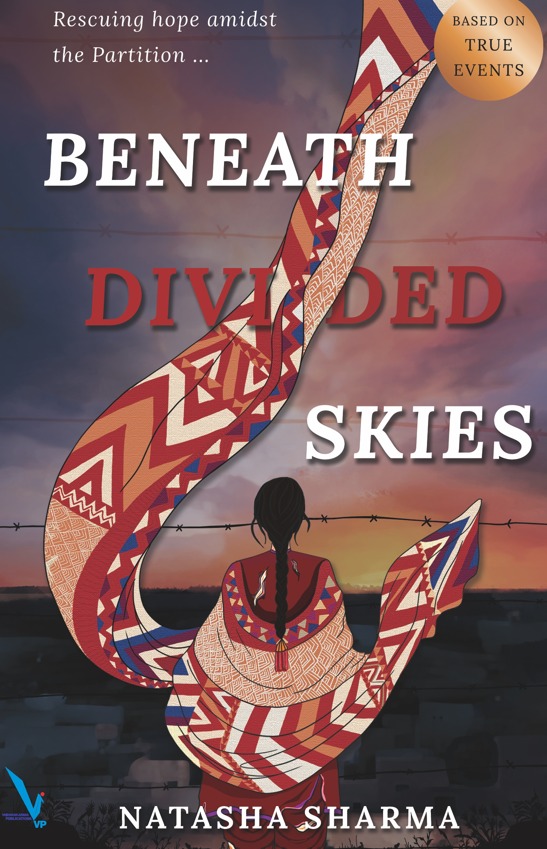
The state calls it “recovery.” Satya learns what it really is: an official second kidnapping. After Partition, abducted women became state business. In the early months of independence, India and Pakistan established official recovery operations to locate and “restore” women who’ve been taken, hidden, or forcibly absorbed into new lives across the border. Files are opened, trains arranged, names recorded, and bodies moved under the language of humanitarian duty. But the work is riddled with contradictions: families demand return, governments demand closure, and the women themselves are rarely asked what home means after rupture. What is described as rescue often becomes something far more ambiguous. An extraction carried out in the name of honour, nationhood, and unfinished violence.
A young social worker turned undercover operative in India’s covert recovery network, Satya, alongside her formidable mentor, Prerna Maasi, is sent across the border to retrieve abducted women from Pakistan—missions where rescue is never clean, and return is never simple. Missions based on the real but largely forgotten Abducted Persons (Rescue and Restoration) Act. As she moves through smugglers, refugee camps, and the cold machinery of state directives, Satya confronts the brutal truth behind restoration: some women do not want to be found, and some cannot be saved without being broken all over again. Her work is dangerous not only because of the physical risks, but because every mission forces her and other rescuers to answer an impossible question.
What does it mean to be saved, and who gets to decide?
Beneath Divided Skies opens with Satya and her team on a high-stakes operation to extract a captive girl, Santosh, from Pakistan. The rescue is successful, but the aftermath reveals the deeper truth of this world.
Survival does not end at retrieval. Women return carrying trauma, silence, and complicated loyalties, and Satya begins to realise that repatriation can become its own form of violence when it ignores choice. At Panah Ashram, a government-aided refuge initially created by Prerna and a network of women operatives, survivors rebuild their lives through fragile solidarity and simple vocations. Rejected by families and branded untouchable, they find dignity again in community. Phulkari embroidery becomes both livelihood and metaphor: intricate stitches formed from devastation, proof that something living can still emerge from ruin.
Running through the narrative is Satya’s own psychological unravelling. Her work demands emotional detachment, but she is not immune to the lives she touches, nor to the dangerous intimacy of crossing into enemy territory again and again. The same territory where she lost her family, and where her only sister, Preeto, was abducted during the violence. Preeto’s absence is the real catalyst behind Satya’s decision to join the recovery unit, even as the missions slowly hollow her out. Her work draws her into an uneasy alliance with a compassionate Pakistani Army officer, Capt. Iqbal Sultan Syed. Despite the impossible circumstances—an Indian and a Pakistani, their nations bleeding in the name of religion—a forbidden love ignites between them, shaped by grief as well as by longing.
In Iqbal’s company, Satya experiences how love can release one from the prison of the past. Yet she is aware their love is doomed. She cannot imagine a future in Pakistan, the land of her nightmares, and he cannot abandon his own life without becoming another casualty of history. Back in India, Satya throws herself into rebuilding, working alongside Ikankar, a fellow Indian officer whose steadiness offers her a different kind of refuge. Though she tries to forget Iqbal, his letters continue to arrive, filled with unwavering tenderness. When Preeto is finally rescued, Satya believes she will at last find closure. Instead, she is confronted with the deepest ambiguity of all: Preeto chooses, with Prerna Maasi’s support, to return to the husband and children she has built a life with in Pakistan. The decision shatters Satya’s understanding of rescue and forces her to accept that restoration cannot undo history.
Ikankar, who loves Satya deeply, waits patiently, allowing her time to heal. Eventually, Satya accepts a marriage built on respect, friendship, and mutual admiration—lacking the incandescent spark she shared with Iqbal, yet stronger for its steadiness. Together, they build a home in Delhi, carrying with them a Partition-woven family of survivors like Santosh and others whose lives remain intertwined with Satya’s.
Years later, during an ordinary family evening, Satya’s daughter questions whether the violence depicted in the Partition-based serial Tamas might be exaggerated. Shocked by the younger generation’s distance from this history, and still haunted by what she has lived through, Satya embarks on a final mission: creating a museum dedicated to the displaced, the abducted, and the silenced—a place for testimony, remembrance, and healing.
She travels to Pakistan once more, confronting the geography of her own past, and finds a measure of closure to her trauma. At the museum’s inauguration, fate intervenes again. And there in the audience stands Iqbal, etched with the lines of time. Their reunion is bittersweet. A recognition of longing and acceptance, and the understanding of a love that could never survive history, yet was never erased by it.
Spanning the immediacy of undercover rescue operations and the long afterlife of trauma, Beneath Divided Skies is a sweeping, deeply humane novel about women caught between borders, about the politics of restoration, and about the intimate cost of rebuilding a nation. It illuminates a lesser known chapter of Partition history—one in which rescue is never clean, love is never safe, and survival is only the beginning.