
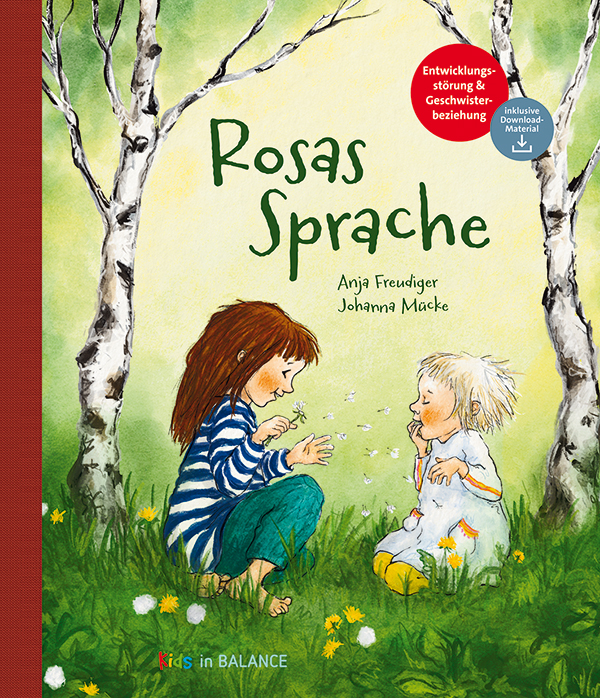
Anni loves her little sister Rosa very much. Wanting to make her happy, she plans a surprise — a Carnival party just for Rosa! Full of excitement, Anni prepares everything with great anticipation. But the loud noises and colorful decorations are too much for Rosa. When she lashes out and the guests run away, Anni feels disappointed and ashamed.
With Papa’s help, Anni begins to understand that Rosa experiences the world differently. Over time, she learns to read Rosa’s special language — a soft hum, a flutter of arms, a clicking sound. She records her discoveries in a little dictionary. In the end, she is rewarded in the most beautiful way: with Rosa’s loud, throaty laughter.
Lovingly illustrated, this picture book tells the story of the special bond between siblings with and without developmental disabilities. It shows the challenges they face, as well as the beautiful, unexpected moments of closeness they share. A book for children and families that invites understanding and compassion — and shows that there are many ways to communicate with one another.
Illustrations: Johanna Mücke is an educator and works as an illustrator
Anni had wished for a little sister for such a long time. She waited so impatiently for Rosa back then. She still remembers how fidgety and happy she was when she held the baby in her arms for the very first time. Even though it’s not always easy being Rosa’s big sister, Anni loves her very much.
Anni proudly looks at the picture she has just painted. Rosa will definitely like it!Anni now paints colorful dots around the picture. Each little circle is a different color. She tilts her head thoughtfully to one side. The dots look like confetti. Anni and Rosa in a shower of confetti! Just like at Carnival.
Only a few more days to go, then it will finally be time!
“I love everything about Carnival! The colorful balloons, the streamers, dressing up and putting on face paint, the funny dances we learned at school—just everything!” Anni explains as she throws her arms around Mama. Mama is busy stuffing laundry into the machine, but she laughs anyway.
“Rosa likes Carnival just as much as I do, right, Mama?” Anni beams. “I’ll show her everything! She’s going to be amazed!”
“I’m not so sure about that, Anni …” Mama replies evasively, turning toward the dryer.
Anni can’t remember Rosa ever being at a parade or a party before. “Rosa will love it just as much as I do. We’re sisters, after all! It’s going to be wonderful! I’ve got a great idea!” she giggles softly as she hops excitedly through the apartment.
A Carnival party just for Rosa! While doing her homework, Anni daydreams about how happy Rosa will be. About the party songs from school that they’ll sing together and dance to. About all the balloons Anni will blow up. They could even have guests if the neighbor kids, Amanda and Niko, have time. Rosa will surely throw her arms around Anni with joy—just like her little baby cousin Erik often does.
Anni grabs the money from her piggy bank and sets off whistling toward the supermarket to buy chips, balloons, and streamers.
But then everything turns out very differently from Anni’s daydreams.
“Rosa, we’re celebrating Carnival! I’ve prepared a party just for you!” Anni calls out to her little sister.
Rosa steps hesitantly into the decorated hallway, where streamers hang from the cupboards and sway from the doorknobs.
Anni has put in an enormous amount of effort and spent all her pocket money. She starts singing her favorite Carnival song at the top of her voice and hops from side to side. Rosa is sure to love this!
But Rosa covers her ears and turns away from Anni. Confused, she stares at a fluttering streamer.
Anni knows that Rosa doesn’t know many words yet, but she could have at least said “thank you”! Instead, she yanks the rustling paper streamers off the doorknob and tears them into tiny pieces. She’s ruining everything! That makes Anni really angry.
When the two neighbor kids Anni invited for Rosa ring the doorbell, Rosa gets all excited, but she doesn’t pay any attention to her guests at all. She just paces restlessly up and down the dining room and flaps her hands.
The witch’s hat Anni wanted to put on Rosa’s head lies crumpled in the corner. Rosa simply won’t keep it on.
Niko watches Rosa with a frown, and Amanda asks uncertainly, “What is your sister doing, Anni?”
But Anni can’t explain it to her. She only knows that Rosa does this a lot —
and she feels embarrassed about her little sister.
The worst part comes when Rosa discovers the balloons.
At first, she flaps her arms wildly with excitement, and Anni happily thinks that maybe she really has managed to make Rosa glad.
But then Rosa starts pressing and squeezing the balloons. She runs her fingers over the rubber surface so that sharp squeaking noises fill the room. And Rosa squeaks just as loudly. Her face is tense and no longer happy at all, but she still doesn’t stop. Shrill squeaking, again and again. And then Rosa even starts biting into the balloons!
Then it happens: one of the balloons bursts under Rosa’s sharp teeth, and Rosa begins to scream. She rocks her upper body back and forth and bangs her head against the bookshelf over and over again.
Niko and Amanda quietly slip out through the apartment door. Anni notices it out of the corner of her eye.
Why won’t Rosa just stop? Anni tries to hold her, but her sister kicks at her.
Mama comes running and sends Anni out of the room. She makes sure Rosa doesn’t hurt herself any further and stays with her until she calms down. But it takes a long time.
Tears run down Anni’s face. Why can’t Rosa be like other children? Why didn’t she just stop? And why does she never let Anni hug her? Then Anni feels a hand on her back.
It’s Papa.
“Why wasn’t Rosa happy?” she sobs. “Why doesn’t she like me? I tried so hard!” Papa sighs. “Rosa sometimes shows her love and her feelings differently from us. She has her own special language for it — one that isn’t easy to understand right away.
A language all her own. Anni has never thought of it that way before. She talks with Papa about Rosa for a long, long time. And she decides she’s really going to learn Rosa’s language.
Rosa sits in the living room, humming softly. She’s sorting her little dolls. Anni lies down next to her, very carefully. All the dolls are arranged in a row — the biggest on the left, the smallest on the right, all facing the same direction. And Rosa smiles calmly.
Anni is learning the Rosa-language now — a little more every day. Rosa’s mouth doesn’t say much, but Anni can read what Rosa’s body tells her.
Her flapping arms say: “I’m so excited! Be careful — it might get too much for me soon!”
Her rocking body says: “Everything will be okay …” Her clicking sounds say: “I’m content.”
Papa gives Anni a small notebook. She writes down every new Rosa-sentence she learns. On the first page, in her neatest handwriting, she writes:
“Rosa’s language translated into Anni’s language.”
In the garden, Anni watches Rosa walk the same path over and over.
All the grass there has already been trampled flat. Rosa must have walked that loop at least a hundred times. Always in a circle. That must be terribly boring! But Rosa makes happy clicking sounds.
So Anni does what her little sister does: she runs her fingertips over the plants along the worn path and over the bark of the trees she passes.
And all at once, she understands why clicking can make you happy.
Suddenly, Rosa grabs Anni’s arm. She pulls her sister over to the water pump on the garage wall and places Anni’s hand on the lever. Anni knows what that means. She’s supposed to pump. Rosa holds her hand under the stream of water. She flaps her arms with excitement, sending droplets flying everywhere. When the water slows to a trickle, Rosa still stands next to Anni for a moment, her hand outstretched.
Then she looks at her sister — straight into her eyes! And Anni understands and starts pumping again.
In the evening, Anni stands at her wide-open window, letting the fresh air in. Her Rosa-book lies open on the windowsill. She writes: “When Rosa looks at me, it means: I trust you — you can surely understand me.”
The days grow longer, summer arrives, and the Rosa-book collects water splashes and grass stains from the garden. But it fills up more and more.
And one day, Anni sees Rosa waiting for her at the front door after school.
When Rosa spots Anni, she laughs — a loud, throaty Rosa-laugh that comes flying toward her with wide, flapping arms.
And Anni laughs too.