
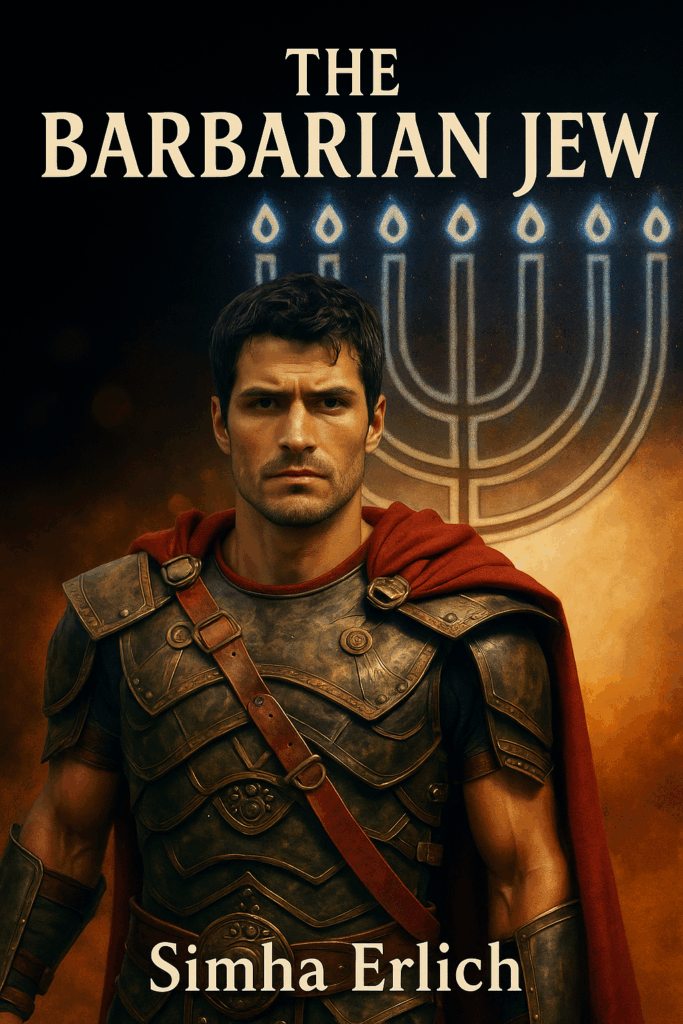
Can a devout Jew become a wild barbarian warrior?
The novel “Shimon and Gaiseric” tells that story.
It follows Shimon, a boy from a traditional Jewish family raised in Rome, who—after a traumatic event—is captured by a barbarian warrior tribe. All the elements of a historical novel are here: intrigue, fast-paced action, hidden motives, and a love story. Yet this novel stands apart thanks to the unique period it portrays—the turbulent fifth century CE, when the mighty Roman Empire was weakening and finally collapsing under the repeated invasions of savage tribes. It was an era of upheaval, brutal wars, and deep uncertainty.
As the reader journeys through this distant time, he encounters the Roman world at the dawn of Christianity, as well as the barbarian tribes—their daily lives and their times of war. The reader is swept away to far-off places in time and space, yet remains close in its exploration of human motives and desires.
The novel also sheds light on one of the most fascinating tribes of that stormy age—the Vandals—and on Jewish life and identity in a largely unknown historical period. It offers a fresh and captivating perspective on a question that has stirred Jewish and non-Jewish imagination for two millennia:
Where are the sacred vessels of the Temple?
Shimon and Gaiseric – A Journey of Identity, Faith, and Civilization’s Collapse
Shimon and Gaiseric is an ambitious historical novel that transports the reader to the fifth century CE, one of the least explored eras in Hebrew literature — the turbulent period between the decline of the Roman Empire and the rise of the barbarian kingdoms. Against the backdrop of a collapsing world order, it tells the gripping and deeply human story of Shimon, a young Jewish boy from Rome who is captured by a barbarian tribe, assimilates into their wild culture, and eventually rediscovers his lost identity and faith.
The novel intertwines epic historical drama with an intimate spiritual journey, exploring what it means to be human when culture, faith, and identity are stripped away. It asks timeless questions: Can a person truly lose their origins? Can faith survive when civilization collapses? And what remains of one’s soul when all social frameworks vanish?
A Lost World Reimagined
The fifth century was a turning point in world history. The once-mighty Roman Empire was crumbling under its own weight — political corruption, economic decay, and endless invasions by northern tribes: Vandals, Goths, Huns, and Franks. The novel situates its story in this chaotic transition between eras — when the old gods and the new faith of Christianity still coexisted uneasily, and when Jewish communities in the Empire faced both persecution and assimilation.
Into this fractured world steps Shimon, a Roman-born Jew raised in a devout, tradition-keeping family. His upbringing reflects the delicate balance of Roman urban sophistication and Jewish piety. But the stability of his world is shattered when barbarian raiders — likely Vandals — sweep through his region. During the chaos, Shimon is captured and taken north as a prisoner or slave.
His capture marks not only a physical displacement but also the beginning of a profound spiritual exile. Torn from the rhythms of Jewish ritual life, surrounded by warriors who speak strange tongues and worship primal gods, Shimon faces an impossible choice: resist and perish, or adapt and survive.
From Captive to Warrior
In a stunning reversal of fate, Shimon’s intelligence, courage, and adaptability earn him the tribe’s respect. Gradually, he becomes one of them — a warrior, trained in their customs and blood rites. The author paints this transformation with both empathy and tension: we witness a boy shedding his past, but also sense the quiet tragedy of forgetting who he was.
The barbarian tribe, while violent, is not portrayed as one-dimensional. Their life is raw, passionate, and governed by its own moral codes — loyalty, courage, kinship, and reverence for nature and ancestry. Through Shimon’s eyes, the reader experiences a world without books or prayers, yet with codes of conduct, belief, ceremonies and art.
As the years pass, Shimon learns their ways, fights in their wars, and even forms close bonds within the tribe — including, perhaps, a love story that deepens his inner conflict. Yet, as he rises in their ranks, a hidden tension grows: an unspoken yearning for something beyond the tribal drumbeats and the glory of battle.
The Awakening
At the heart of Shimon and Gaiseric lies a spiritual reawakening. The turning point comes when Shimon encounters symbols or memories from his past — perhaps a fragment of Hebrew prayer, a vision, or a meeting with another Jew in exile. These moments awaken the dormant consciousness of his earlier self.
He begins to realize that while he has gained power and belonging, he has lost something far greater: his spiritual center. His rediscovery of his Jewish soul is neither romanticized nor simple — it comes with guilt, confusion, and pain. He is a man divided between two worlds, a hybrid being who can no longer fully belong to either.
The novel portrays this tension as both personal and civilizational. Just as Shimon is torn between barbarism and faith, so too the ancient world itself is torn between paganism and monotheism, order and chaos, the fading empire and the dawning of medieval Europe.
Gaiseric and the Vandal Kingdom
The novel’s title alludes to Gaiseric (Genseric), the historical king of the Vandals who conquered North Africa and famously sacked Rome in 455 CE. Geizerik, both a historical figure and a symbolic presence, embodies the unstoppable tide of barbarian conquest that reshaped Europe.
In the story, he may appear directly or serve as an emblem — the embodiment of worldly power that destroys civilizations but cannot conquer the human spirit. The Vandals themselves are portrayed not merely as destroyers but as founders of a new world order. Through them, the author explores the paradox of creation through destruction: how the collapse of Rome paved the way for new identities, faiths, and ideas to emerge.
Style and Language
The prose of Shimon and Gaiseric is often described as rich, lyrical, and visual. The author combines historical realism with poetic intensity, evoking landscapes of forests, deserts, and ruined cities with vivid sensory detail. The language carries echoes of biblical Hebrew (in the original version), creating a tone that feels both ancient and timeless.
This stylistic choice deepens the novel’s spiritual undertones. The reader senses the tension between the mythic and the historical, the sacred and the earthly. Every battle, every dialogue, every internal struggle resonates on multiple levels — as both concrete narrative and symbolic allegory.
The pacing alternates between moments of fast-moving action — raids, marches, and battles — and introspective passages where Shimon reflects on the nature of freedom, belonging, and faith. This rhythm mirrors the dual nature of his journey: the outward adventure and the inward pilgrimage.
Themes and Motifs
At its core, Shimon and Gaiseric is a meditation on identity, faith, and the fragility of civilization. Among its central themes:
The Broader Vision
Beyond the personal story, Shimon and Gaiseric offers a philosophical reflection on history itself. The fall of Rome is not portrayed merely as a tragedy, but as an inevitable cycle — the death of one civilization making room for the birth of another. In this sense, Shimon’s individual journey mirrors the transformation of the world: from classical order to medieval faith, from material grandeur to spiritual introspection.
The novel thus bridges two great narratives — the epic of history and the intimate drama of the soul. Its power lies in showing the eternal questions of human existence: Who am I? What do I believe in? What is worth preserving when everything else falls apart?
Conclusion
Shimon and Gaiseric is not a conventional historical adventure but a profound literary meditation on identity, exile, and redemption. It speaks to modern readers as much as to historians, reminding us that every age faces its own kind of collapse — political, moral, or spiritual.
Through Shimon’s odyssey from captivity to belonging, from loss to rediscovery, the novel reveals that faith and humanity can survive even in the darkest times. Its pages echo with both the roar of battle and the whisper of prayer, uniting the violent and the sacred in one haunting vision.
In the end, Shimon and Gaiseric stands as an achievement in Hebrew historical fiction — a sweeping epic and a spiritual quest in one, illuminating the eternal human struggle between chaos and order, exile and homecoming, barbarism and belief.