
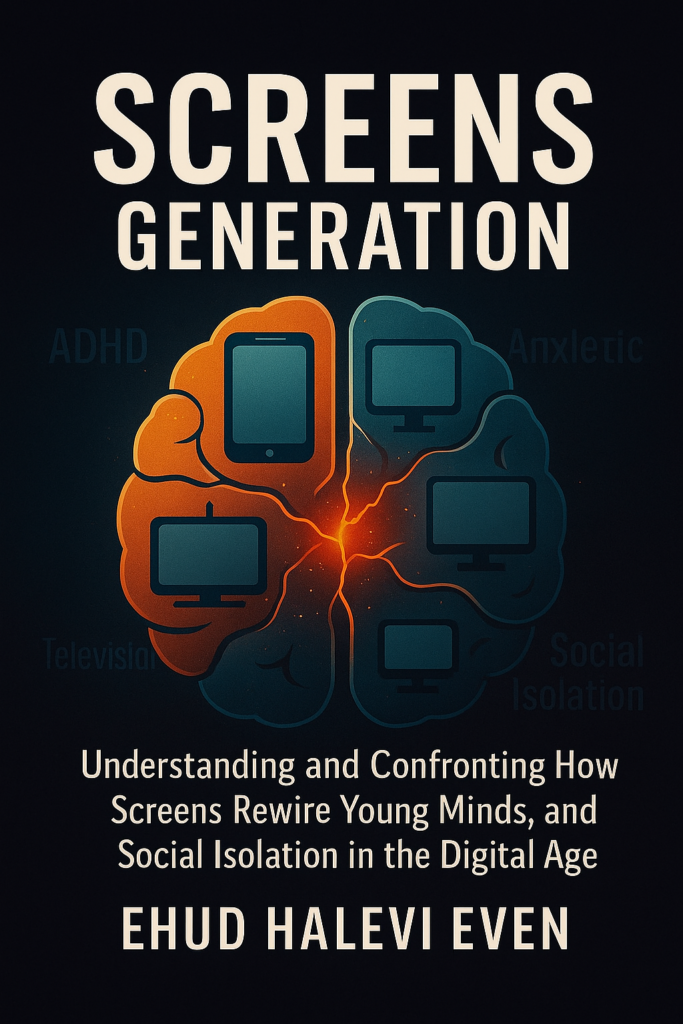
The Screen Generation is a compelling, timely, and thought-provoking nonfiction book that explores one of the most significant challenges of our time: the impact of digital technology on human behavior.
The book’s strength lies in its ability to connect psychology, technology, education, and human relationships, presenting complex issues in an accessible and engaging manner. The author combines insights into the mechanisms behind digital influence with practical approaches to navigating the challenges of an increasingly connected world.
What makes The Screen Generation particularly valuable is its balanced perspective. Rather than simply warning readers about the dangers of technology, it encourages them to reconsider their relationship with it and seek a healthier balance between technological progress, meaningful human connection, independent thinking, and personal freedom.
Generation Screens is a comprehensive and timely educational-social work that confronts one of the most urgent questions of our era: how the digital world is reshaping the brains, emotions, and daily lives of children and adolescents—and what we, as parents, teachers, and educators, can do to guide them toward balanced, mindful, and healthy use of technology. Written in a lucid and compassionate voice, the book seeks not to condemn technology but to understand it, and to build a bridge between neuroscience, psychology, and practical education.
Part I: Understanding the Screen Generation
The opening chapters describe the digital revolution as one of the most profound cultural transformations in human history. Within a single decade, screens have entered every corner of life—the living room, the classroom, and even the bedroom. This shift has redefined time, communication, and identity itself.
The “screen” offers unprecedented access to knowledge, creativity, and connection, yet it simultaneously alters the way the brain learns and regulates emotion. The human brain—evolved for single, discrete stimuli—is now exposed to a constant flood of visual and auditory input. Neuropsychological studies cited in the book show that prolonged screen exposure increases activity in the brain’s reward (dopaminergic) system while weakening the prefrontal cortex, the region responsible for self-regulation, planning, and impulse control.
The author also explains how the amygdala—the brain’s emotional centre—and the stress system (which releases cortisol) become overstimulated, leading to emotional volatility and fatigue. This helps to explain why many children find it difficult to put down their phones, and why their moods oscillate between excitement and exhaustion.
The book explores how screens shape identity and social connection: children and teens now construct their sense of self through a digital feed of images, likes, and followers. Self-worth becomes tied to instant social validation. The result is a culture of comparison, fear of missing out (FOMO), and social anxiety—yet also one of self-expression and community. For some, online spaces provide belonging that is hard to find offline. The key question is not whether screens are “good” or “bad”, but how we can teach the next generation to use them wisely.
Part II: The Challenges—Addiction and Emotional Impact
In the second part, Halevi Even examines the psychological mechanisms behind screen use. Through vivid examples—such as a student named Omer, who would rather stack every chair in school than surrender his iPhone for a day—the book illustrates the depth of emotional dependency.
Screen interaction activates three core systems of the brain: curiosity, anticipation, and variable reward. Like a slot machine, every swipe or scroll holds the promise of a “win”—a funny video, a message, a like. The uncertainty triggers dopamine release, creating an addictive feedback loop that keeps the user seeking the next stimulus instead of being present in the moment.
The book explains how tech companies exploit these mechanisms deliberately, using colour alerts, vibrations, and delayed notifications to maintain user engagement. This, Halevi Even argues, is not a personal weakness but a product of deliberate design targeting the brain’s reward circuitry.
Emotionally, screen use often functions as escape. A bored, lonely, or anxious child turns to the screen for relief—receiving temporary comfort that deepens long-term dependence. A repetitive cycle emerges: negative feeling → screen use → brief relief → emptiness → repeat.
Over time, this loop results in emotional fatigue, attention problems, loss of motivation, and a sense of emptiness. Studies quoted in the book indicate that more than two hours a day on social media doubles the risk of depression and social isolation among adolescents. Physical outcomes such as weight gain, sleep disorders, and reduced physical activity are also discussed.
The book explores gender and biological differences as well: boys are drawn to competition and control, while girls are more vulnerable to social comparison and appearance-based validation. Hormonal factors—testosterone and oxytocin—further influence emotional responses. The author also points to social and geographic inequalities: children from disadvantaged backgrounds often consume lower-quality content, reinforcing educational and emotional gaps.
A dedicated chapter examines the attention economy: how global tech giants like Google, Facebook, and TikTok compete for humanity’s most valuable resource—our attention. They design user experiences to keep us emotionally aroused, using psychological reinforcement patterns that generate vast profit for corporations but psychological exhaustion for users.
Part III: Not Only a Threat—An Opportunity
Despite its critical tone, Generation Screens emphasises that the digital era also presents extraordinary opportunities. Technology enables personalised learning, global access to information, creative thinking, and cross-cultural collaboration.
The book presents inspiring examples of students who use artificial intelligence to enhance their abilities—learning languages, coding, or producing films and art. Yet it also warns of overreliance on intelligent tools: when AI “thinks for us”, curiosity and depth decline. Halevi Even calls for the teaching of digital literacy—the ability to identify reliable sources, understand algorithmic influence, and cultivate critical thinking.
He stresses the need to strengthen the mind’s “cognitive muscles”: focus, self-control, and delayed gratification. Children must learn to master screens rather than be mastered by them. The screen is not an enemy—it can become a tool for growth and creativity, if used consciously.
Part IV: Practical Tools for Parents, Teachers, and Communities
This section provides concrete strategies for prevention and intervention. For parents, the key is not “fighting screens” but fostering dialogue and partnership. Instead of criticism, the book advocates conversation: “Let’s see together how screens affect you.”
It recommends family digital agreements defining usage boundaries, as well as practical tips: screen-free zones, tech-free days, role modelling, and shared activities.
Teachers are presented as agents of change. The book encourages educators to integrate technology into learning creatively—not as a threat but as a field for exploration—and to identify students showing signs of digital distress.
For communities, Generation Screens proposes building digital resilience through parent workshops, social-emotional learning (SEL) programmes, and staff training to detect early signs of addiction. The message is clear: prevention begins not with prohibition but with connection, meaning, and warmth.
Part V: The Collective Brain and a Look to the Future
In its concluding chapters, the book expands the lens to a global scale. In the networked age, humanity functions like a “collective brain”—a worldwide nervous system where emotions, fears, and desires spread in real time. The author warns of emotional synchronisation leading to herd behaviour and manipulation, yet also envisions how this connectivity can be harnessed for empathy, activism, and collaboration.
The closing vision is optimistic: a generation capable of mastering its screens rather than being ruled by them. The choice, Halevi Even writes, remains ours.
Generation Screens calls for a renewed investment in education for values—presence, compassion, cooperation, and mindfulness—and for integrating digital ethics and privacy into school curricula. The book ends with a personal appeal: to restore to children their capacity to be present, to think, to feel, and to dream—even without a screen.
The Book’s Contribution
Generation Screens is far more than a social study; it is a guide to healing and hope. Written in accessible language, it interweaves scientific research, real-life stories, and practical tools, offering a balanced approach: not demonising technology, but redefining our relationship with it.
Its strength lies in addressing three interconnected levels:
Ultimately, the book encapsulates the challenge of our time in a single, resonant idea:
Technology is not the problem—it is the mirror.
We must teach ourselves and our children to look into it, understand what it reflects, and choose again how we wish to live.