
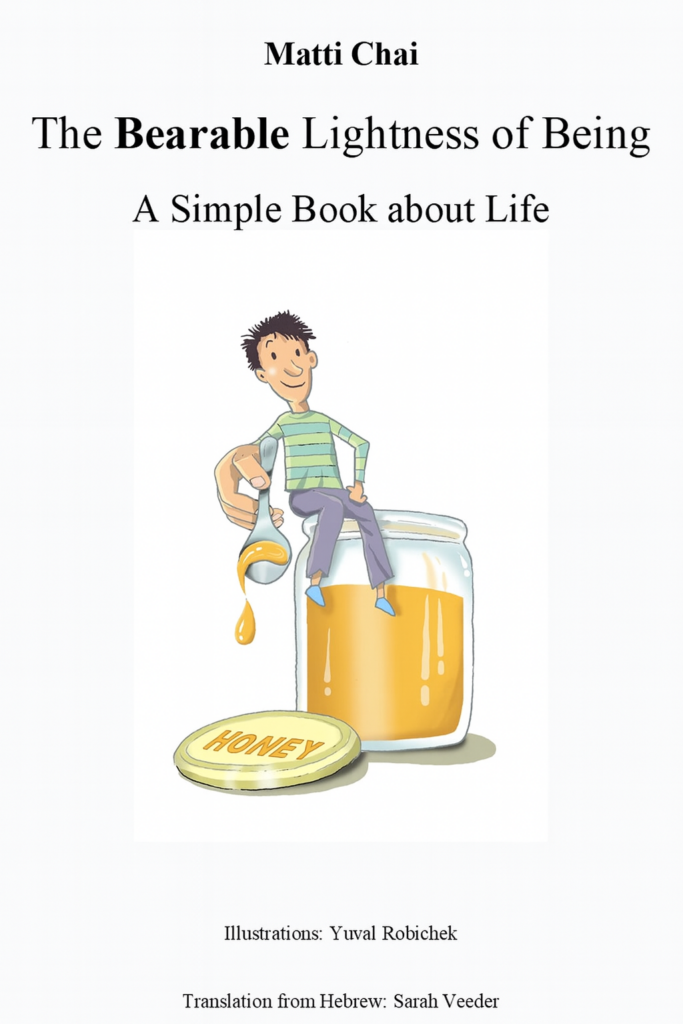
This compelling and self-reflective book is about life, reconciliation, and optimism, and offers guidance for the future. The authors’ parents had endured unimaginable horrors during the Holocaust, but kept living as best they could, while his mother wallowed in survivor’s guilt. The loss of her first husband and their children had damaged her child-raising skills, with her fears creating a distance in her love of the son from her second marriage—the author. In later life, mother and son were able to work through these issues. The author received the unconditional love he needed from his father and was able to embark on a life of gratitude.
Matti Chai’s soulful insights and reflections are images to which we can all relate—on birth, death, and life with all its struggles.
This book sold over 8,000 hardcopies in Hebrew in Israel.
The Bearable Lightness of Being is a philosophical reflection on life written as a “simple book for adults” by Matti Chai, the son of Holocaust survivors. Paraphrasing the title of Milan Kundera’s famous novel, this work presents accessible ideas about living meaningfully without requiring philosophical training. The author approaches life with optimism despite his parents’ traumatic past, having deliberately changed his surname to “Chai” (meaning “alive” in Hebrew) as a symbolic commitment to choosing life.
Background and Perspective
Matti Chai grew up as an only child to Josef and Helen Chimowitz, both Holocaust survivors who had lost their first families. His mother survived camps, disguised herself as a gentile, and fought as a partisan, yet carried lifelong survivor’s guilt after her first husband and two children had perished. She worked tirelessly but denied herself joy, remaining critical and depressed. Chai’s father, who had lost his first wife and four children, chose gratitude instead—thanking God for survival, the opportunity to rebuild and to work the Land of Israel. He remained optimistic, generous, and smiling despite his losses.
Growing up in this household, Chai had every reason to become depressed. Instead, he consciously rebelled against pessimism, choosing to enjoy life and express gratitude for what exists rather than lamenting what does not, and recognizing that in almost every situation, what we have exceeds what we lack. For over fifty years, he has found purpose in connecting young and older people with nature, the Land of Israel, its people, and heritage—always with joy and optimism.
Core Philosophy: Three Key Concepts
Chai identifies three essential keywords: interest, purpose, and meaning. He focuses on three fundamental life topics: our death, our parents, and our children. Rather than providing definitive answers, he poses questions, acknowledging that “there will always be more questions than answers”—echoing Bertrand Russell’s view that the primary function of philosophy is to raise questions rather than providing solutions.
Death and Mortality
Live every day as if it is your last while planning as if you will be here forever.
The author argues that awareness of death, rather than being a limitation, represents our greatest advantage if properly utilized. Since death is the only certainty in life, and the primary cause of death is birth itself, why do we measure life’s duration rather than its quality and meaning? Chai challenges readers to consider whether they could summarize their lives today with satisfaction, asking: What have we done beyond earning a living? Have we fulfilled our purpose? Have we been good, decent, honest human beings?
He suggests we should live in light of—not in the shadow of—our eventual “life-review conversation.” Drawing on Epicurus, he notes that we never actually encounter death: while we exist, death is absent; when death arrives, we no longer exist. Fear of death paralyzes and limits possibilities, whereas acceptance gives us the ability to live fully and experience satisfaction daily. Chai’s father exemplified this approach, maintaining peace and completeness even on his death bed.
Modern Society’s Trap
Chai sharply criticizes Western consumer culture, arguing that the advertising and marketing industry deliberately creates dissatisfaction by establishing ideals we can never reach. This manufactured gap between reality and aspiration generates frustration, compelling us to spend money continuously. Marketers use words such as “progress” and “development” to make us feel inadequate, driving an exhausting race that empties our wallets and sometimes our homelands.
He contrasts this with people he met in Kenya, Ladakh, and the Amazon—individuals who have never heard of “happiness” as a concept, yet embody it. They live simply, laugh freely, cry openly, are not frustrated or complicated, take only what they need from nature, and sleep soundly despite difficult conditions. Most significantly, they have no mental health issues because there is no gap between their reality and aspirations. Although Western society might dismiss them as living in a “fool’s paradise,” Chai asks: Isn’t that the state we’re all trying to reach?
Parents
Chai emphasizes unconditional gratitude toward parents for giving us life—the greatest gift. Although parents make mistakes and there is inherent conflict between parents’ and children’s interests, most parents have good intentions. The author underwent a difficult but rewarding process of reconciliation with his mother before her death, learning to love her and releasing years of resentment.
He boldly asserts: “Until we reconcile with our parents, it’s doubtful we’ll succeed in reconciling with ourselves.” A beautiful custom he describes from Kibbutz Tirat Zvi has those whose parents are alive recite a prayer on Yom Kippur, acknowledging their own responsibility and the special rights of their parents throughout life.
Children
Chai claims that bringing children into the world is entirely selfish—we want someone to be a continuation of our lives and to fulfill our unaccomplished dreams. This imposes one-directional, lifelong responsibility. Children need unconditional love and acceptance without the expectation of repayment, because everything we do for them, we ultimately do for ourselves.
Chai criticizes two main characteristics of modern parenting: abundance and excessive consideration. Overabundance leads to satiation, laziness, indifference, and atrophy. Overprotection prevents children from learning through experience and developing resilience. He contrasts this with Maasai and Samburu children who are given significant responsibility at young ages and thus develop self-worth and accountability.
Parents are required to prepare children for life’s challenges and not to shield them excessively. Education begins at birth, and parents teach primarily through behavior, not words. Chai advocates trusting intuition—the golden mean between emotion and intellect—and being prepared for the inevitable day when children hold us accountable, responding simply: “I did my best, to the best of my understanding.”
Practical Wisdom
The author references Reinhold Niebuhr’s serenity prayer about accepting what cannot be changed, courageously changing what can, and wisely distinguishing between them. He emphasizes that anything unsolvable isn’t really our problem. We should change what we don’t like about ourselves immediately, if possible, but accept what cannot be changed rather than remain frustrated.
Awareness teaches us our capabilities and limitations—objective facts, not value judgments. We shouldn’t compare ourselves to anyone else. The author shares how, after experiencing profound loneliness following his girlfriend’s departure and friends moving away, he realized that: “Even if I were stranded on a desert island I wouldn’t be alone—I’d have myself, and the self is an awful lot.”
Conclusion
Chai hopes readers will take something from his reflections and apply it to their own lives. He emphasizes two fundamental recognitions: the perception that each person is unique with no reason to imitate others, and the knowledge that, although we are “all-powerful” in our lives, we are completely temporary in this world. This knowledge becomes our ethos and compass, making us recognize our self-worth while remaining humble.
The book encourages us to live the life we choose—not the one designated by others—using our intelligence and reason. Rather than being academic or theoretical, it presents accessible wisdom by someone who has found meaning and joy despite having every reason for pessimism. As Chai’s father’s example showed: gratitude, optimism, and choosing life are themselves revolutionary acts in a world that often encourages quite the opposite.